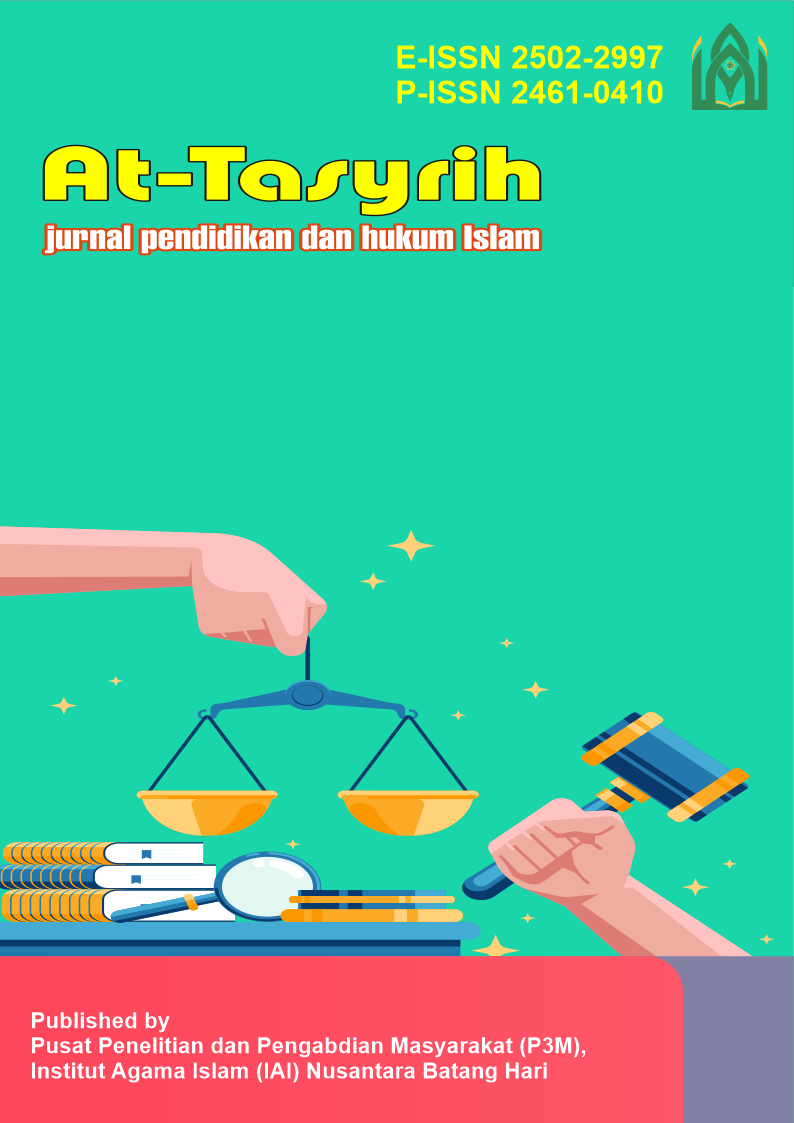
PAMONE SEBAGAI NEGOTIATED CUSTOMARY MAHR: OTORITAS ADAT, AGENSI PEREMPUAN, DAN LEGITIMASI HUKUM ISLAM DI RAMPI, INDONESIA
DOI:
https://doi.org/10.55849/attasyrih.v12i2.588Keywords:
hukum Islam, mahar, Pamone, pluralisme hukum, tradisi adatAbstract
Mahar dalam masyarakat Muslim tidak selalu ditentukan semata-mata oleh doktrin hukum Islam, tetapi juga melalui interaksi dengan adat, struktur keluarga, dan kondisi sosial-ekonomi. Namun, studi mutakhir masih terbatas dalam menjelaskan bagaimana otoritas lokal membentuk kadar mahar dan bagaimana praktik tersebut memperoleh legitimasi sosial sekaligus keagamaan. Penelitian ini menganalisis mekanisme penentuan kadar mahar dalam tradisi Pamone di Kecamatan Rampi, Kabupaten Luwu Utara, serta menilai kedudukannya dalam perspektif hukum Islam. Penelitian menggunakan pendekatan kualitatif lapangan dengan strategi studi kasus; data diperoleh melalui observasi, wawancara purposif dengan tokoh masyarakat, tokoh adat, dan tokoh agama, serta dokumentasi, kemudian dianalisis secara tematik dan normatif. Temuan menunjukkan bahwa Pamone telah bergeser dari standar adat yang relatif kaku menuju mekanisme yang lebih adaptif dan negosiatif. Kadar dan bentuknya dipengaruhi oleh acuan adat, riwayat keluarga, kemampuan ekonomi, musyawarah, dan persetujuan perempuan, sementara kewajiban yang belum terpenuhi tetap dipandang mengikat setelah perkawinan. Artikel ini berargumen bahwa Pamone lebih tepat dipahami sebagai negotiated customary mahr, yakni praktik mahar adat yang memperoleh legitimasi melalui adaptasi sosial dan kesesuaiannya dengan prinsip kerelaan, kemudahan, hak perempuan, dan pencegahan kemudaratan.
References
Akurugu, C. A., Dery, I., & Domanban, P. B. (2022). Marriage, bridewealth and power: Critical reflections on women’s autonomy across settings in Africa. Evolutionary Human Sciences, 4, e30. https://doi.org/10.1017/ehs.2022.27
Akurugu, C. A., Domapielle, M. K., & Jatoe, M. M. (2021). Bridewealth, women’s subordination and agency in marriage: An ethnographic critique of gender activism in rural north-western Ghana. Journal of Asian and African Studies, 56(8), 1819–1833. https://doi.org/10.1177/0021909621992783
Asni, A., Tarmizi, T., Arisyanti, A., & Kurniati, K. (2025). Sompa and Doi Menre in Bugis Bone marriage and its settlement in the Religious Court from the perspective of maslahah. Samarah: Jurnal Hukum Keluarga dan Hukum Islam, 9(2), 1012–1033. https://doi.org/10.22373/r4qw6859
Brandl, E., & Colleran, H. (2024). Does bride price harm women? Using ethnography to think about causality. Evolutionary Human Sciences, 6, e29. https://doi.org/10.1017/ehs.2024.21
Busyro, B., Burhanuddin, N., Muassomah, M., Saka, P. A., & Wafa, M. A. (2023). The reinforcement of the “dowry for groom” tradition in customary marriages of West Sumatra’s Pariaman society. Samarah: Jurnal Hukum Keluarga dan Hukum Islam, 7(1), 555–578. https://doi.org/10.22373/sjhk.v7i1.15872
Chae, S., Agadjanian, V., & Hayford, S. R. (2021). Bridewealth marriage in the 21st century: A case study from rural Mozambique. Journal of Marriage and Family, 83(2), 409–427. https://doi.org/10.1111/jomf.12725
Djawas, M., Nurdin, A., Zainuddin, M., Idham, I., & Idami, Z. (2024). Harmonization of state, custom, and Islamic law in Aceh: Perspective of legal pluralism. Hasanuddin Law Review, 10(1), 64–82. https://doi.org/10.20956/halrev.v10i1.4824
Djawas, M., Ridhwan, R., Yusof, W., Said, W., & Nadhiran, H. (2023). The integration between syara’ and ade’ in marriage tradition Bugis Bone, South Sulawesi. AL-IHKAM: Jurnal Hukum & Pranata Sosial, 18(2), 342–363. https://doi.org/10.19105/al-lhkam.v18i2.10373
Dutta, S. (2023). Polygamy and the porous state: Reconstituting gender in the everyday life of Muslim law. Legal Pluralism and Critical Social Analysis, 55(2), 180–200. https://doi.org/10.1080/27706869.2023.2170161
Friantoro, D., & Susamto, A. A. (2021). The determinants of the value of mahr in Muslim societies: Evidence from the Indonesian Family Life Surveys. Jurnal Ekonomi & Studi Pembangunan, 22(2), 323–338. https://doi.org/10.18196/jesp.v22i2.11918
Hasan, H., Jubba, H., Abdullah, I., Pabbajah, M., & Rahman, A. R. (2022). Londo iha: Elopement and bride kidnapping amongst the Muslims of Monta, Bima, Indonesia. Cogent Social Sciences, 8(1), 2023973. https://doi.org/10.1080/23311886.2021.2023973
Hotte, R., & Lambert, S. (2023). Marriage payments and wives’ welfare: All you need is love. Journal of Development Economics, 164, 103141. https://doi.org/10.1016/j.jdeveco.2023.103141
Jacobs, C., Chevalier, D., & Stapper, M. (2024). Legal pluralism in the urban realm: An introduction. Legal Pluralism and Critical Social Analysis, 56(1), 4–12. https://doi.org/10.1080/27706869.2024.2320000
Jannah, S., Mufidah, C. H., & Suwandi, S. (2021). Panaik money of Bugis’ customary marriage in the perspective of Islamic law and positive law in Indonesia. Journal of Transcendental Law, 3(2), 98–111. https://doi.org/10.23917/jtl.v3i2.17375
Luthfi, M., Fajrin, Y. A., & Bachtiar, H. (2024). The existence of ‘urf in the resolution of marriage disputes in Islamic law: A living law perspective. Jurnal IUS Kajian Hukum dan Keadilan, 12(1), 146–158. https://doi.org/10.29303/ius.v12i1.1356
Manse, M. (2024). The plural legacies of legal pluralism: Local practices and contestations of customary law in late colonial Indonesia. Legal Pluralism and Critical Social Analysis, 56(3), 328–348. https://doi.org/10.1080/27706869.2024.2377447
Ostadalidehaghi, R., Roshan, M., Ghasemi, M., & Farhang, M. (2026). Rethinking mahr: Gendered bargaining, legal institutions, and women’s economic security in Iran’s welfare regime. Journal of Family Theory & Review, Advance online publication. https://doi.org/10.1111/jftr.70084
Pemerintah Republik Indonesia. (1991). Instruksi Presiden Republik Indonesia Nomor 1 Tahun 1991 tentang Penyebarluasan Kompilasi Hukum Islam. https://peraturan.bpk.go.id/Details/293351/inpres-no-1-tahun-1991
Raman, D. (2024). Enforceability of mahr under a sharīʿa law-based contract in New Zealand: A comparison with United Kingdom, Australia, and Canada. International Journal of Law, Policy and the Family, 38(1), ebae020. https://doi.org/10.1093/lawfam/ebae020
Rasyid, Y. A., Aziz, F., Djamaludin, D., & Tyas, P. R. (2024). Reconstructing the concept of Uang Panai in South Sulawesi: A maqāṣid al-sharī‘ah approach for revitalizing women-friendly Islamic values. Al-Ahkam: Jurnal Ilmu Syari’ah dan Hukum, 9(1), 1–13. https://doi.org/10.22515/alahkam.v9i1.8706
Showkat, A. (2023). The principle and practice of mahr in Muslim marriages. Feminist Theology, 31(2), 197–209. https://doi.org/10.1177/09667350221134992
Wirastri, T. D., & van Huis, S. C. (2021). The second wife: Ambivalences towards state regulation of polygamy in Indonesia. The Journal of Legal Pluralism and Unofficial Law, 53(2), 246–268. https://doi.org/10.1080/07329113.2021.1912579
Downloads
Published
How to Cite
Issue
Section
License
Copyright (c) 2026 FAJAR RAHMAT AZIZ, Hilya Amalia, Luthfia Rahma, Nurul Hidayah Amsur, Siti Magrifah

This work is licensed under a Creative Commons Attribution-ShareAlike 4.0 International License.